
Running a small B2B agency comes with a unique set of challenges, but none are more critical than managing client trust. When a client hires your agency—whether for digital marketing, web development, or financial consulting—they are handing over the keys to their business. You gain access to their social media accounts, content management systems, and proprietary data.
If a single employee at your agency mishandles a password and compromises a client’s account, it is not just an operational setback; it is a reputation-destroying disaster. Small agencies are frequently targeted by cybercriminals precisely because they often lack the massive IT budgets of enterprise corporations.
To protect your business and your clients, you must establish strict cybersecurity protocols. Here are the five best password practices every B2B agency needs to implement immediately.
1. Eliminate the “Shared Spreadsheet” Immediately
The most common—and most dangerous—mistake small agencies make is storing client credentials in a shared Google Sheet or Excel file. While it seems convenient for collaboration, spreadsheets are entirely unencrypted. Anyone with the link can copy, download, or accidentally delete the entire database. If you are serious about protecting client assets, migrating away from plain-text storage to an encrypted environment is the absolute first step you must take.
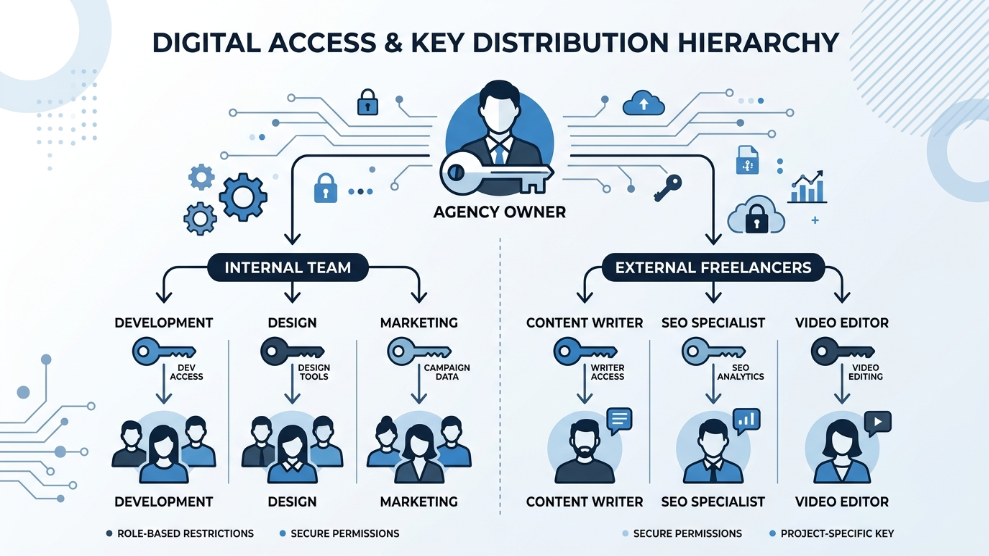
2. Enforce Role-Based Access Control (RBAC)
Not everyone in your agency needs access to everything. A junior copywriter does not need the master password to a client’s billing portal. Implementing Role-Based Access Control (RBAC) ensures that team members only access the specific credentials required for their daily tasks.
When you securely share passwords with remote freelancers or internal staff, it is highly recommended to use an infrastructure that supports granular permissions. For instance, many top-tier agencies rely on military-grade vaults like Keeper Security to create isolated team folders. This allows founders to grant temporary access, track exactly who logged into what, and instantly revoke permissions the moment an employee leaves the company, ensuring no client data walks out the door.
3. Mandate Multi-Factor Authentication (MFA) Firmly
A strong password is only half the battle. According to cybersecurity guidelines from organizations like the National Cybersecurity Alliance, enabling Multi-Factor Authentication (MFA) stops the vast majority of automated account takeover attacks. You must create an agency-wide policy that mandates MFA on every single internal tool (like Slack, Asana, or email) and every client account that supports it. This ensures that even if an attacker guesses an employee’s password, they cannot access the agency’s network without the physical secondary device.
4. Streamline Client Onboarding and Logins
Time is money in an agency. If your team spends ten minutes every morning hunting down the correct client passwords or struggling to fill out complex ad-account setups, your operational efficiency drops.
A great password practice is to combine security with productivity. Instead of manually typing credentials, your team should utilize automated systems. By equipping your staff with highly accurate form-filling vaults such as RoboForm, employees can securely log into dozens of client portals and navigate complex multi-page setups with a single click. This drastically reduces the temptation for employees to save passwords directly in their vulnerable web browsers just to save time.
5. Conduct Regular Credential Audits
Client relationships end, team members resign, and projects evolve. Over time, your agency accumulates digital clutter. You should conduct a comprehensive password audit at least once a quarter. This involves reviewing who has access to your active shared folders, changing the passwords of accounts that former employees touched, and ensuring no client credentials are left lingering in dormant channels.
By utilizing automated security dashboards that highlight weak, old, or reused passwords, you can effortlessly identify vulnerabilities within your team before hackers do.
Final Thoughts
In the B2B world, cybersecurity is a massive competitive advantage. When pitching to a new, high-ticket client, being able to confidently explain your agency’s rigorous, encrypted password practices proves that you are a professional, trustworthy partner. By eliminating shared spreadsheets and adopting encrypted, role-based password management, you secure your agency’s future and reputation.

Munir is a digital security researcher and software reviewer
with over 5 years of experience testing privacy tools, parental
control applications, and cybersecurity software. He founded
Tech Monitor Pro to provide honest, hands-on reviews that help
families and professionals make smarter decisions about the
tools they use online. When he is not testing the latest VPN
or email verification platform, he writes practical guides on
digital safety and online privacy.