

Imagine a thief standing in front of a massive apartment complex. Instead of picking the lock of a single door for hours, he takes one master key that fits 10% of all standard locks and quickly tries it on every single door in the building. He doesn’t need to break into every apartment; he just needs to find the few that haven’t changed their default locks.
In the world of cybersecurity, this is known as a Password Spraying Attack.
As we navigate the digital landscape of 2026, hackers have moved away from the “brute force” method of attacking one person at a time. Instead, they use automated bots to “spray” common, weak passwords across thousands of accounts simultaneously. If you are still using easy-to-guess passwords, you are the exact target they are looking for.
In this guide, we will break down how this attack works and provide you with an actionable plan to ensure your accounts remain impenetrable.
How Password Spraying Works
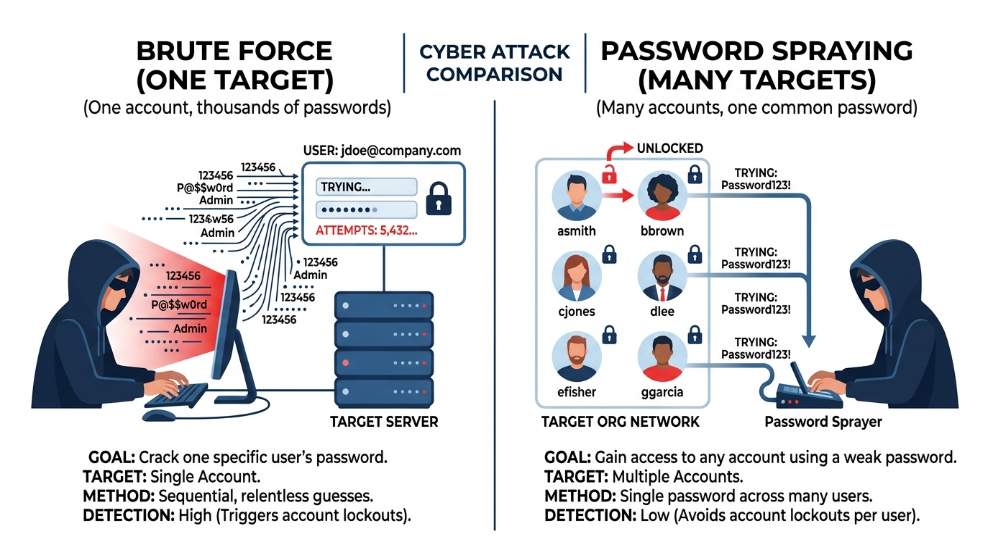
Unlike a traditional brute force attack—where a hacker tries thousands of password combinations against a single username until they get lucky—password spraying is a “low and slow” tactic.
- The Target List: The attacker gathers a list of thousands of usernames or email addresses (often from leaked databases on the dark web).
- The Common Password: They choose a handful of very common passwords, such as
Password123,Welcome2026, orSummer!. - The Spray: An automated script tries the same common password across every single username on the list.
- Bypassing Security: Because the script only tries one or two passwords per account before moving on, it often bypasses “account lockout” policies that usually trigger after 3 or 5 failed attempts.
According to the Cybersecurity & Infrastructure Security Agency (CISA), password spraying is one of the most successful methods for gaining initial access to corporate and personal networks because it exploits human psychology—our tendency to choose “easy” passwords.
Password Spraying vs. Brute Force: The Difference
While they sound similar, the strategy is fundamentally different:
| Feature | Brute Force Attack | Password Spraying Attack |
| Strategy | Thousands of passwords vs. 1 account. | 1-2 common passwords vs. thousands of accounts. |
| Speed | Fast and aggressive (Easy to detect). | Slow and methodical (Harder to detect). |
| Goal | Force entry into a specific target. | Find any “low-hanging fruit” on a massive scale. |
| Detection | Triggers account lockouts quickly. | Often stays under the radar of security logs. |
How to Stop Password Spraying Attacks in 2026
The good news is that while these attacks are common, they are also very easy to prevent if you follow modern security protocols.
1. Enable Multi-Factor Authentication (MFA)
This is your first and most important line of defense. Even if a hacker successfully “sprays” your password and gets it right, they still cannot access your account without the second factor (like a code from an authenticator app or a biometric scan).
2. Use Complex, Unique Passwords
Hackers spray common words. If your password is a random string of 16+ characters, it will never be on a “spraying” list. However, remembering unique passwords for every site is impossible for a human—which is why you need a professional vault.
The Expert Solution: Proactive Password Management
To truly protect yourself, you need to migrate your digital life into an encrypted environment that identifies weak passwords and monitors for breaches. Following our strategy of using high-quality security reviews, we recommend these two tools:
NordPass: Advanced Security Monitoring
NordPass uses next-generation XChaCha20 encryption to ensure your vault is impenetrable. Its built-in “Password Health” tool automatically scans your accounts and flags any weak or reused passwords that are vulnerable to spraying attacks. If your email appears in a dark web leak, NordPass alerts you instantly so you can change your credentials before a hacker even starts their “spray.”
👉 Check our NordPass Review: Is it the most secure vault?
1Password: The “Secret Key” Advantage
For those who want an extra layer of mathematical protection, 1Password is the industry leader. Because it requires a unique 34-character “Secret Key” alongside your Master Password, it is effectively immune to traditional password spraying. A hacker could have your correct password, but without that physical Secret Key stored on your device, they are locked out forever.
👉 Read our 1Password Review: The ultimate vault for 2026
Final Verdict
Password spraying attacks rely on laziness. By choosing a weak password and reusing it across multiple sites, you are making the hacker’s job easy. By enabling MFA and moving your credentials to a dedicated, encrypted manager like NordPass or 1Password, you remove yourself from the target list and ensure your digital identity remains secure.

Munir is a digital security researcher and software reviewer
with over 5 years of experience testing privacy tools, parental
control applications, and cybersecurity software. He founded
Tech Monitor Pro to provide honest, hands-on reviews that help
families and professionals make smarter decisions about the
tools they use online. When he is not testing the latest VPN
or email verification platform, he writes practical guides on
digital safety and online privacy.