
For an e-commerce entrepreneur, there is nothing more terrifying than waking up to the dreaded “Your Amazon Seller Account has been deactivated” email.
Amazon is the largest retail search engine in the world. Having your FBA (Fulfillment by Amazon) or dropshipping business suspended does not just pause your sales; it freezes your inventory, locks up your pending payouts, and can potentially destroy months of hard work.
While suspensions can happen for various reasons—like high defect rates or intellectual property claims—the most devastating and difficult-to-reverse bans occur when sellers attempt to manage multiple storefronts improperly. If you are an agency managing client stores, or an entrepreneur scaling multiple brands, understanding the technical rules is critical. Here is exactly how to avoid Amazon seller account suspensions while operating multiple digital assets.
The “Related Accounts” Violation
According to the official Amazon Seller Code of Conduct, operating multiple Seller Central accounts without a legitimate business justification is a direct violation of their policies. Even if you have permission, if the algorithm suspects you are using one account to manipulate the reviews or sales of another, both accounts will be permanently banned.
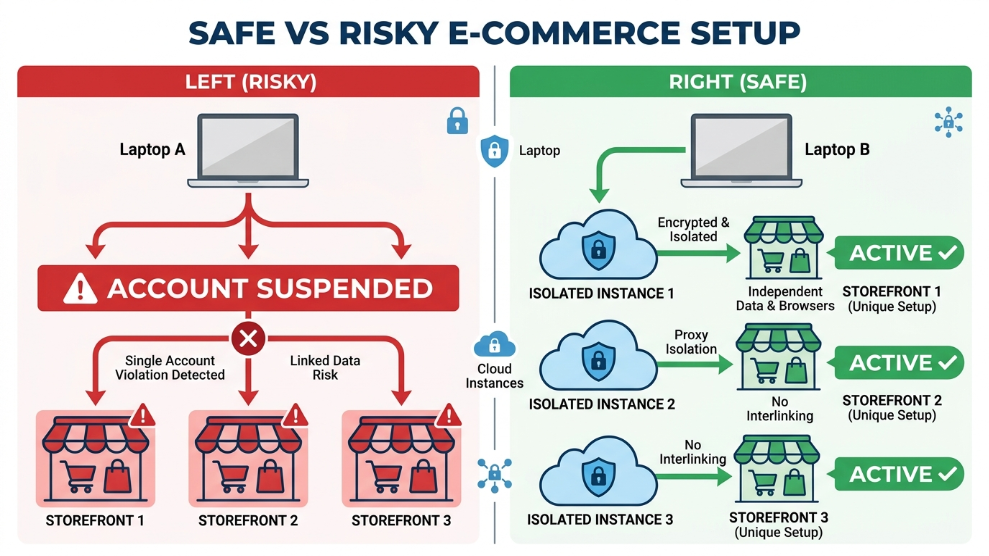
The problem is that Amazon’s AI tracking system is incredibly aggressive at finding “Related Accounts.” If you log into Store A and Store B using the same laptop, the same Google Chrome browser, or the same home Wi-Fi network, the algorithm instantly connects the two stores. If one store gets suspended for a delayed shipment, the algorithm will trigger a chain reaction, automatically banning the second store simply because they share the same digital footprint.
Step 1: Stop Sharing the Same IP Address
You cannot log into multiple Amazon storefronts from the same internet connection. If your virtual assistant in the Philippines logs into your store, and then logs into another client’s store using the same router, Amazon will link both businesses together.
To break this link, you must assign a completely unique, high-quality IP address to every single storefront. As we have discussed previously when comparing residential vs datacenter proxies, using cheap, commercially hosted IPs is highly dangerous for e-commerce. You must use dedicated residential proxies to ensure that Amazon views the connection as a normal, legitimate household connection.
Step 2: Utilize Real-Device Fingerprinting
Amazon’s tracking scripts look far beyond your IP address. They utilize advanced browser fingerprinting to analyze your graphics card, your installed fonts, and your screen resolution.
If you attempt to manage multiple accounts using Incognito mode, Amazon still sees your computer’s underlying hardware. To completely isolate your stores, you need an anti-detect browser.
For solo entrepreneurs and dropshippers, using a platform like MoreLogin is highly effective. Instead of randomly generating fake hardware data, it uses machine learning to assign your profile the exact digital fingerprint of a real, physical device elsewhere in the world. This completely bypasses Amazon’s algorithmic suspicion.
For massive e-commerce agencies managing dozens of multi-million dollar client accounts, absolute security is non-negotiable. In these high-stakes environments, top-tier firms rely on enterprise solutions like Multilogin. Because its dual engines modify the browser at the source-code level, it provides the deepest possible isolation, ensuring that zero hardware data leaks across client accounts.
Step 3: Compartmentalize Your Financial Data
Technical isolation is useless if you make a careless financial mistake. Amazon links accounts based on shared billing information just as quickly as they do based on IP addresses.
If you are managing two legitimate, separate businesses, they must have absolutely zero crossover. This means:
- Separate Bank Accounts: Never use the same deposit account for two different storefronts.
- Separate Credit Cards: Ensure the charge methods on file are completely distinct.
- Separate Legal Entities: Use different LLCs and Tax ID numbers for each brand.
Final Thoughts
Scaling an e-commerce empire on Amazon requires playing by strict, unforgiving algorithmic rules. The days of logging into multiple seller accounts from a single laptop are long gone. By compartmentalizing your financial data, utilizing residential IP addresses, and securing your digital footprints with professional anti-detect software, you can shield your storefronts from cross-account contamination and keep your e-commerce revenue safe.

Munir is a digital security researcher and software reviewer
with over 5 years of experience testing privacy tools, parental
control applications, and cybersecurity software. He founded
Tech Monitor Pro to provide honest, hands-on reviews that help
families and professionals make smarter decisions about the
tools they use online. When he is not testing the latest VPN
or email verification platform, he writes practical guides on
digital safety and online privacy.