

If you are running B2B cold email outreach in 2026, you have likely run your prospect list through an email verification tool. When the results come back, you see the usual “Valid” and “Invalid” tags. But then you notice a large, frustrating chunk of your list labeled as “Catch-All” or “Accept-All”.
Should you email them? Will they bounce? Will they destroy your sender reputation?
Understanding how to handle these specific addresses is the difference between a highly profitable outreach campaign and a permanently blacklisted domain. In this complete guide, we will explain exactly what a catch-all email address is, why businesses use them, and the safest way to handle them in your marketing campaigns.
What is a Catch-All Email Address?
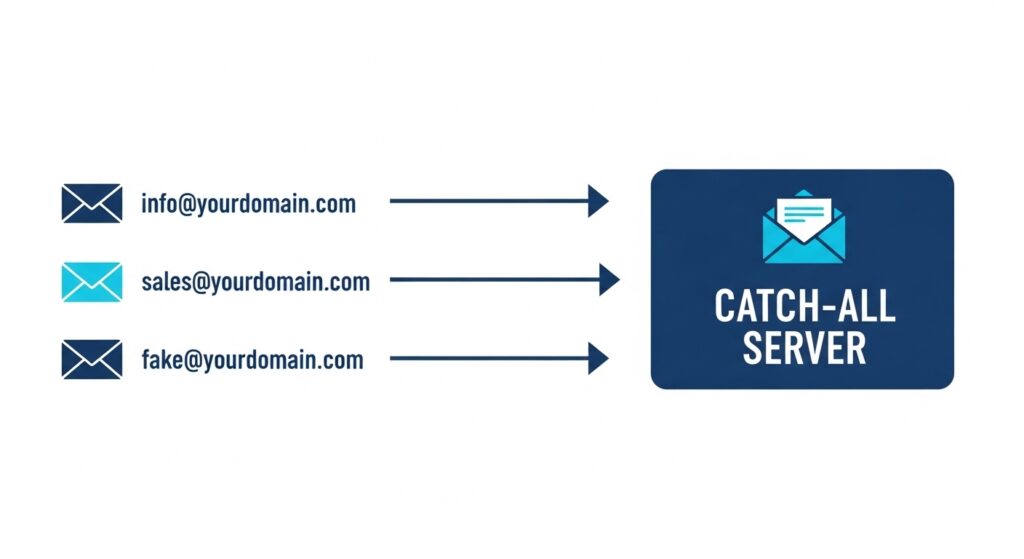
A catch-all email address (often referred to as an “accept-all” domain) is a server configuration set up by a business to ensure they never miss an incoming email.
In a standard email setup, if you send an email to a misspelled address (e.g., joh.doe@company.com instead of john.doe@company.com), the server rejects it, resulting in a hard bounce.
However, if the company has a catch-all configuration, the server is programmed to accept all emails sent to that domain, regardless of whether the specific prefix exists. Instead of bouncing, the misspelled email is routed to a central, generic inbox (like info@company.com or admin@company.com) where a human can review it.
Why Do Businesses Use Catch-All Domains?
From a business owner’s perspective, setting up an accept-all server makes perfect sense.
- Preventing Lost Leads: If a potential client makes a typo while emailing their sales team, the company still receives the inquiry.
- Employee Turnover: When employees leave the company and their specific inboxes are deleted, any emails sent to them will still be caught by the central inbox instead of bouncing back to the sender.
The Danger for Email Marketers
While catch-all domains are great for the business receiving the emails, they are a massive headache for the marketers sending them.
Why? Because traditional email verification works by pinging a server and asking, “Does this inbox exist?” Since a catch-all server is programmed to say “Yes” to everything, the verification tool cannot guarantee if the specific person you are trying to reach (e.g., the CEO) actually owns that exact address.
If you blindly send emails to hundreds of catch-all addresses, you run the risk of your message sitting unread in a massive spam folder, or worse, hitting a hidden spam trap. This is a primary reason why your cold emails are going to spam despite having a supposedly “clean” list.
How to Safely Handle Catch-All Emails in 2026
You should never blindly delete catch-all emails from your list, as many of them belong to high-value B2B decision-makers. However, you cannot treat them like fully verified addresses either. Here is the exact protocol to follow:
1. Use an Advanced Verification Tool
Not all verification tools treat catch-all domains equally. You need a platform that goes beyond simple server pings.
If you want an affordable tool that handles accept-all servers with high precision, our top recommendation is DeBounce. As highlighted in our DeBounce review, their algorithms are highly optimized to minimize the “unknown” status often associated with corporate firewalls.
If your list consists heavily of enterprise-level B2B contacts, you may need to rely on AI. Platforms like ZeroBounce offer advanced “Email Scoring.” As noted in our ZeroBounce review, their AI can analyze catch-all addresses against vast global networks to predict the likelihood of real human engagement, allowing you to separate the good catch-alls from the risky ones.
2. Segment and Trickle-Send
Never send a massive blast to a list of catch-all emails at the same time. Segment your catch-all contacts into a separate campaign. Send emails to them in very small batches (trickle-sending) mixed with highly engaged, verified contacts. This protects your overall deliverability rate.
3. Monitor Your Engagement Metrics
Keep a close eye on the open and reply rates for your catch-all segment. If you notice a complete lack of engagement or a sudden spike in your email bounce rate, pause the campaign immediately and remove those addresses from your database.
Conclusion
A catch-all email address is not inherently dangerous, but it requires careful handling. By understanding that these domains accept everything, utilizing premium validation tools like DeBounce or ZeroBounce to score their validity, and segmenting your outreach, you can safely connect with high-value prospects without risking your domain’s reputation.

Munir is a digital security researcher and software reviewer
with over 5 years of experience testing privacy tools, parental
control applications, and cybersecurity software. He founded
Tech Monitor Pro to provide honest, hands-on reviews that help
families and professionals make smarter decisions about the
tools they use online. When he is not testing the latest VPN
or email verification platform, he writes practical guides on
digital safety and online privacy.