

Ten years ago, the golden rule of multi-accounting was simple: if you wanted to manage a secondary Facebook ad account or an isolated e-commerce store, you built a Virtual Machine. It was considered the pinnacle of digital isolation.
Today, however, the landscape of digital tracking has drastically evolved. The platforms you advertise and sell on have deployed military-grade algorithms that can easily see through older security methods. As a result, the professional media buying and e-commerce industries have almost entirely abandoned Virtual Machines in favor of specialized Anti-Detect Browsers.
If you are setting up a secure infrastructure to manage multiple digital identities, you are likely wondering which technology is actually safer. In the debate of Virtual Machines vs. Anti-Detect Browsers, here is the definitive technical breakdown.
The Old Standard: Virtual Machines (VMs)
A Virtual Machine is exactly what it sounds like: a computer inside a computer. According to cloud infrastructure experts at VMware, a VM utilizes software to simulate hardware, allowing you to run a completely separate operating system (like Windows or Linux) in an isolated window on your main PC.
The Pros: VMs offer excellent local isolation. If you accidentally download a virus inside the Virtual Machine, it usually cannot escape and infect your main computer. Furthermore, it completely separates your cookies, cache, and local file storage.
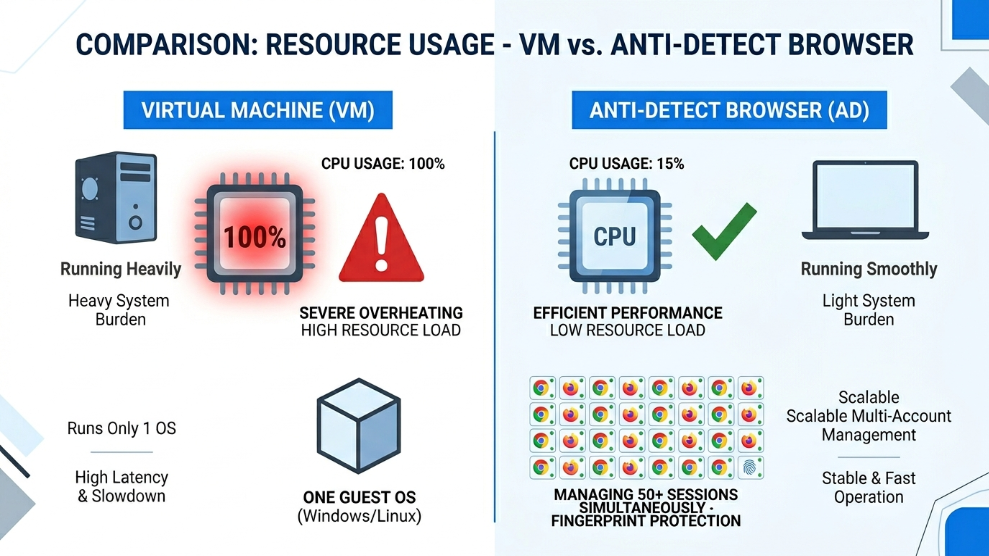
The Cons: The fatal flaw of VMs in modern marketing is resource consumption and hardware leakage. Running a full operating system requires massive amounts of RAM and CPU power. If you try to run five VMs simultaneously on a standard laptop, your computer will likely crash.
More importantly, major platforms (like Google and Amazon) have learned how to detect them. A standard VM does not spoof your hardware; it merely passes your computer’s actual hardware metrics through to the virtualized OS. When the platform analyzes your browser fingerprint, it can see the underlying graphic cards and processors, easily linking your “isolated” VMs together.
The Modern Solution: Anti-Detect Browsers
Anti-detect browsers take a completely different architectural approach. Instead of virtualizing an entire heavy operating system, they only virtualize the web browser itself.
The Pros: Efficiency and advanced spoofing are the primary advantages. Because you are only running a browser tab rather than a full Windows OS, you can comfortably run 50 or 100 isolated profiles simultaneously on a standard laptop.
Furthermore, these tools are explicitly designed to defeat modern algorithms. For example, a platform like MoreLogin does not just pass your real hardware data through; it uses machine learning to assign a completely unique, authentic physical device fingerprint to every single profile.
For massive enterprise agencies managing thousands of accounts, utilizing a premium tool like Multilogin provides source-code level browser modifications. This ensures that even the most aggressive JavaScript tracking scripts cannot detect that the hardware data is being spoofed.
Which is Safer for Multi-Accounting?
If your goal is malware analysis or software testing, a Virtual Machine is the correct choice.
However, if your goal is multi-accounting, affiliate marketing, or e-commerce management, Anti-Detect Browsers are vastly superior and significantly safer. Virtual Machines are too slow to scale and leak too much underlying hardware data to bypass modern tracking algorithms. Anti-detect browsers are lightweight, allow for seamless proxy integration, and provide the exact algorithmic spoofing required to keep your ad accounts and storefronts permanently active.
Final Thoughts
Digital security is a constant arms race. While Virtual Machines were once the ultimate shield for internet marketers, they have become obsolete against the advanced fingerprinting scripts used by modern platforms. By transitioning to a professional anti-detect browser, you can scale your operations faster, use fewer computer resources, and maintain absolute anonymity.

Munir is a digital security researcher and software reviewer
with over 5 years of experience testing privacy tools, parental
control applications, and cybersecurity software. He founded
Tech Monitor Pro to provide honest, hands-on reviews that help
families and professionals make smarter decisions about the
tools they use online. When he is not testing the latest VPN
or email verification platform, he writes practical guides on
digital safety and online privacy.