

For affiliate marketers and CPA arbitrage media buyers, Google Ads is one of the most lucrative traffic sources on the planet. However, it is also the most heavily policed.
If you run aggressive affiliate campaigns, advertorials, or lead generation funnels, it is only a matter of time before you wake up to a red banner at the top of your screen: “Your account is suspended – Circumventing Systems.” When Google drops the hammer, they do not just ban that specific account; they blacklist your entire digital identity. Any new account you try to create from your laptop will be instantly suspended within minutes. So, how do top-tier agencies and high-volume affiliates keep running ads after a ban? They don’t magically unban their old accounts—they build bulletproof, isolated infrastructure for new ones. Here is the exact technical blueprint they use.
The “Circumventing Systems” Trap
To bypass a ban, you must understand how Google caught you in the first place.
According to Google’s official Circumventing Systems Policy, any attempt to bypass their enforcement mechanisms results in an immediate and permanent suspension. Google’s AI is the most sophisticated tracking engine in the world. It looks for connections between your banned account and any new account you create.
If you simply clear your cookies and create a new Gmail address, Google will still catch you using three main vectors:
- Hardware: Your computer’s unique browser fingerprint.
- Network: Your home IP address or Wi-Fi router.
- Financials: The credit card or billing address associated with the account.
If even one of these elements matches your previously banned account, your new account is doomed.
Step 1: Replace Your Hardware Identity
You cannot run a new Google Ads account from the same physical computer that received the ban. However, buying a new $1,000 MacBook every time an account goes down is not a viable business model.
Instead, professional marketers use anti-detect browsers. These tools create deeply isolated digital environments. For media buyers running high-volume campaigns, platforms like Dolphin Anty are considered industry standards. When you create a new profile in Dolphin Anty, the software generates a completely unique, randomized (yet mathematically authentic) hardware fingerprint. To Google’s tracking scripts, the new browser profile looks exactly like a brand-new physical computer located somewhere else in the world, completely breaking the hardware link to your banned account.
Step 2: Acquire Clean Residential IPs
Once your hardware is spoofed, you must change your internet connection.
Do not use commercial VPNs to run Google Ads. Google’s algorithm instantly flags datacenter IP addresses (like those used by NordVPN or ExpressVPN) as highly suspicious, which will trigger a manual review of your new ad account.
As detailed in our comparison of residential vs datacenter proxies, you must route your new anti-detect profile through a high-quality residential proxy. This assigns your account a genuine household IP address (from an ISP like AT&T or Comcast), giving your new profile maximum human authenticity.
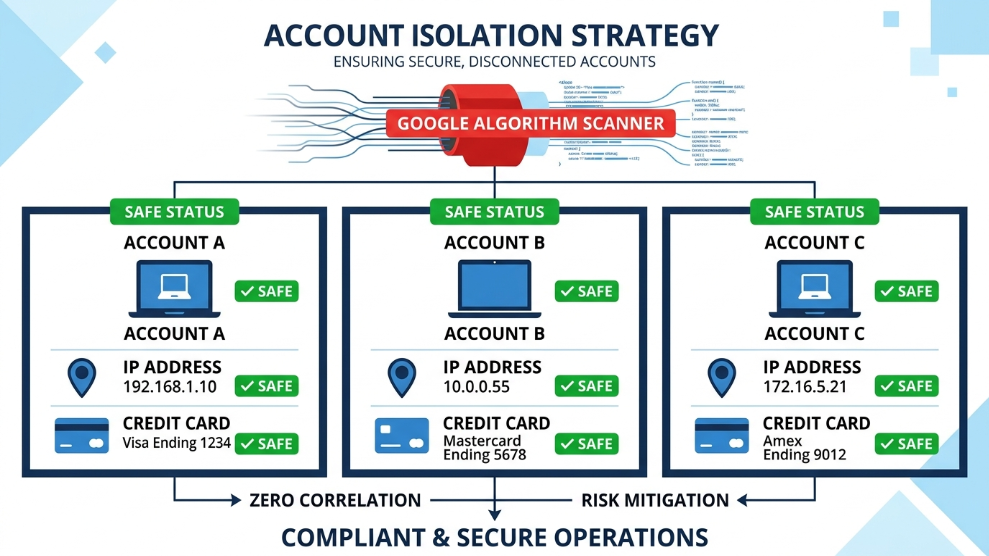
Step 3: Compartmentalize Your Billing and Domains
The final step is severing all financial and asset links. Google shares data across its entire ecosystem.
- Payment Methods: You cannot use the same credit card, or even a different card with the same exact billing address and name. Marketers use high-limit Virtual Credit Cards (VCCs) that allow for custom billing details to fund new accounts safely.
- Domains and Hosting: Never run ads to a domain that was previously linked to a suspended account. Furthermore, ensure your new landing pages are hosted on a completely different server IP, as Google actively scans the hosting environments of the URLs you promote.
Final Thoughts
Bypassing a Google Ads ban is not about hacking the system; it is about perfect digital compartmentalization. By treating every new ad account as a completely separate, isolated business entity—with its own unique hardware fingerprint, residential IP address, and financial data—affiliate marketers can safely resume their campaigns and scale their revenue without fear of algorithmic retaliation.

Munir is a digital security researcher and software reviewer
with over 5 years of experience testing privacy tools, parental
control applications, and cybersecurity software. He founded
Tech Monitor Pro to provide honest, hands-on reviews that help
families and professionals make smarter decisions about the
tools they use online. When he is not testing the latest VPN
or email verification platform, he writes practical guides on
digital safety and online privacy.